INDIE GAMES

Adelaide Remake

Back Alley Tale

Touch It Rikka

Yamanes Love Life
EXCLUSIVE GAMES

Fredina Nights Club

Minesters Touch It Rikka

My Dystopian Robot Girlfriend

Sloven Classmate




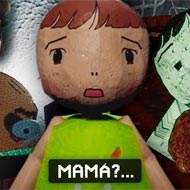
Family Secrets 1: Empty Plate looks, on the surface, like a story about an older brother babysitting for a few days — but it plays like a slow unraveling of exactly what that responsibility costs him. There’s no monster chasing you through the halls here; the horror is built entirely out of an ordinary home starting to feel wrong.
| Genre | Short psychological horror |
| Perspective | First-person |
| Playtime | About 30–40 minutes |
The story follows Miko, left in charge of his younger sibling Jun after their mother calls to say she’ll be away for work for several days. There’s no character creation, no class selection, and no major branching choices — Family Secrets 1: Empty Plate is a short, linear playable story rather than an open structure, and the entire game takes place inside a single house.
What makes the setup effective is how mundane it starts. A parent being briefly absent and an older sibling stepping up isn’t inherently a horror premise, and the game leans on that ordinariness before slowly tipping the tone into something less safe.
There’s no combat system, no inventory to manage, and no upgrade tree — progression comes entirely from exploring rooms, checking objects, and triggering the next story event. That simplicity keeps the focus on Miko and Jun rather than on any mechanical layer, and it’s part of why the game reads closer to an interactive short story than a traditional horror game with systems to learn.
The empty plate referenced in the title ties directly into the game’s central concerns — food, care, and the responsibility of making sure someone else is fed. A hide-and-seek sequence later in the house is one of the moments players bring up most often in reactions and clips, and it marks a clear shift from the domestic setup into something more overtly unsafe.
Players drawn to narrative-first horror tend to get the most out of Family Secrets 1: Empty Plate, since anyone expecting jump-scare density over story will find the pacing much slower than that.
One thing worth being upfront about: the sequence of events toward the end is genuinely disputed among players. Comments on the game specifically raise confusion over the order in which certain events occur — whether the children are searching for food before or after a particular turning point, and whether they’re already gone by the time their father is shown taking money. This isn’t a case of players missing something obvious; the ambiguity appears to be intentional, and it’s one of the more debated aspects of an otherwise short, tightly-focused story.
The listed playtime is roughly 30 to 40 minutes, matching its structure as a short, linear playable story rather than a longer multi-chapter game.
Movement uses WASD, E interacts with objects and dialogue, F toggles the flashlight for darker rooms, and ESC pauses or resumes the game — there’s no combat or inventory system to learn beyond that.
Player discussion suggests the ambiguity around event order — particularly around the father and the timing of certain events — is a deliberate part of the storytelling rather than an error, though it remains one of the most debated parts of the game.
Short as it is, Family Secrets 1: Empty Plate leaves a heavier mark than its 30-to-40-minute runtime suggests, mostly because Miko and Jun’s situation stays uncomfortably plausible even after the flashlight goes out for the last time.